




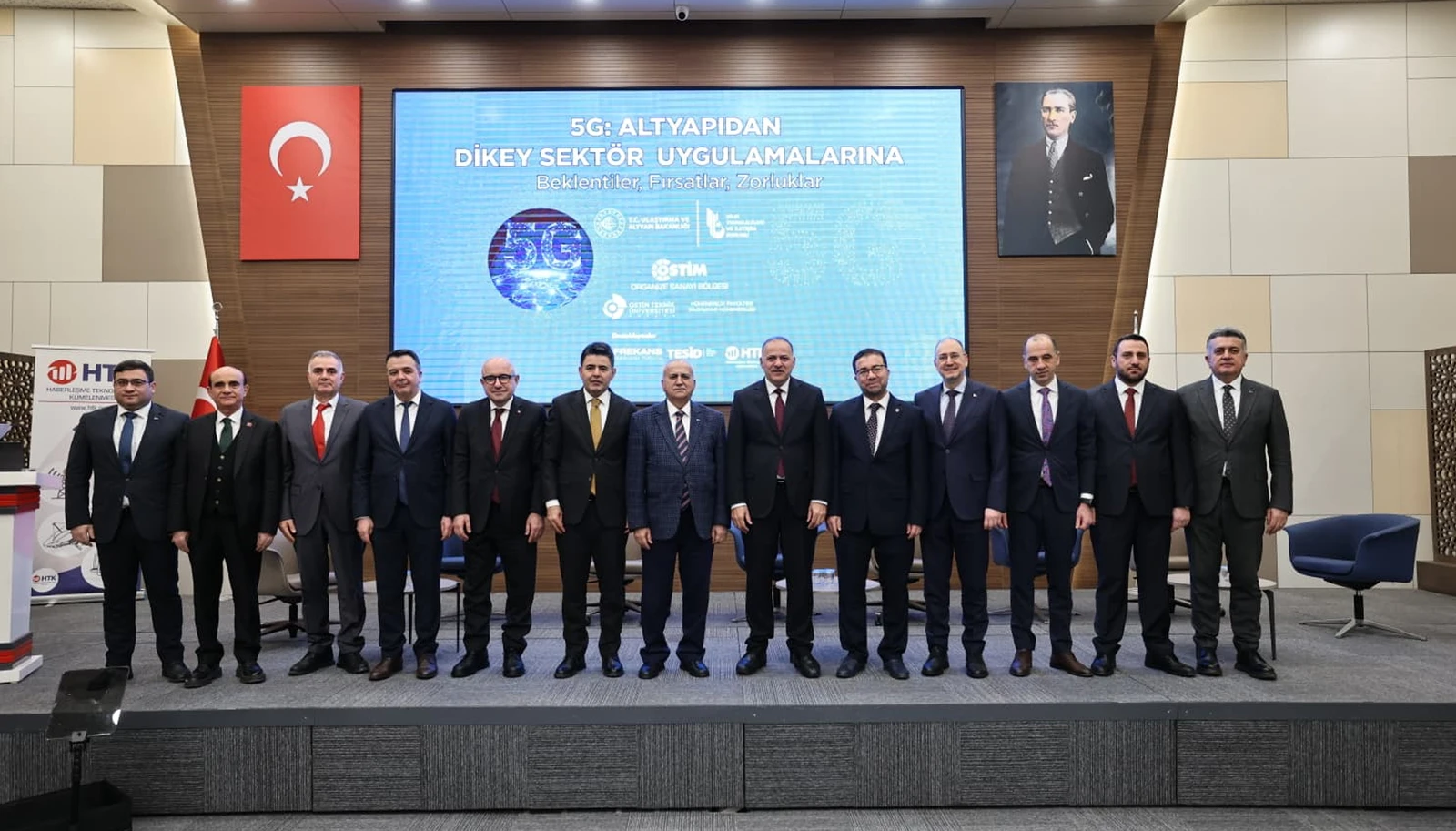
OSTİM Technical University hosted the “5G: Expectations, Opportunities and Challenges in Vertical Sector Applications from Infrastructure” Workshop. At the workshop, Deputy Minister of Transport and Infrastructure Dr. Ömer Fatih Sayan made evaluations regarding the role of next-generation mobile communication technologies in Turkey's digital transformation.
Stating that technology is not an end in itself but a tool that accelerates development when used correctly, Sayan expressed that the real power of 5G lies not only in speed but in what connectivity enables. He said that 5G offers an infrastructure layer on which new solutions can be built, thanks to its ability to enable a large number of devices to communicate with low latency simultaneously and to run AI-based applications in real time.
Conveying that there are approximately 2.6 billion 5G connections worldwide, Sayan noted that the technology is spreading at an unprecedented speed in mobile communication history, and it is expected that the number of connections will reach 9 billion by 2030. He emphasized that, looking at this picture, 5G has become the fastest-adopted generation of mobile communication.
Stating that the impact of 5G in the field is clearly seen in areas such as industry, logistics, and health, Sayan said that private 5G networks increase efficiency in production lines, provide capacity increases in ports with smart traffic and drone monitoring systems, and significantly accelerate diagnostic processes in health.
Indicating that the 5G process in Turkey is progressing with planned and concrete steps, Sayan reminded that 5G frequencies were allocated to operators through the authorization process carried out in 2025. Sayan, who stated that this development is an indicator that Turkey has entered the implementation phase in its 5G journey, said that Turkey will meet 5G signals as of April 1, 2026, and coverage will be expanded gradually.
Emphasizing that they do not approach 5G only from the perspective of faster mobile internet, Sayan conveyed that real usage scenarios are being tested in the field with pilot applications conducted in industrial zones, logistics centers, and airports.
Sayan stated that strong fiber infrastructure, domestic and national technologies, and qualified human resources are the fundamental elements of the 5G ecosystem, and that as the public sector, they will continue to stand on the side that accelerates investment and forms a secure framework.
Touching upon the importance of cybersecurity in his speech, Sayan expressed that security is an inseparable part of the 5G-6G journey, and that Turkey is strengthening its institutional capacity in this field.
Underlining that 5G is not a goal but a starting point, Sayan stated that the Century of Turkey will be the century of those who lead technology, not those who follow it.
President Karagözoğlu: 5G is the Digital Backbone of the Century of Turkey
BTK President Ömer Abdullah Karagözoğlu, who spoke at the workshop, pointed out that with its low latency times and high device density, 5G is the digital backbone of the Century of Turkey vision and a strategic technology platform that will maximize efficiency.
President Karagözoğlu said, “With the frequency auction we held on October 16, 2025, we allocated a total of 400 MHz of frequency in the 700 MHz (Megahertz) and 3.5 GHz (Gigahertz) bands. With this allocation, we brought more than 3.5 billion dollars into our state's treasury; however, we imposed a very clear condition: We placed obligations on our operators to use domestic and national products in increasing proportions over the years. We clearly reflected our determination to increase the localization rates from the 4.5G period above 60% in 5G into our authorization specifications. We see this approach as a strategic choice that also strengthens our technological independence. On the other hand, the domestic communication ecosystem, formed with the support of our Ministry and BTK, is producing concrete outputs today.”