




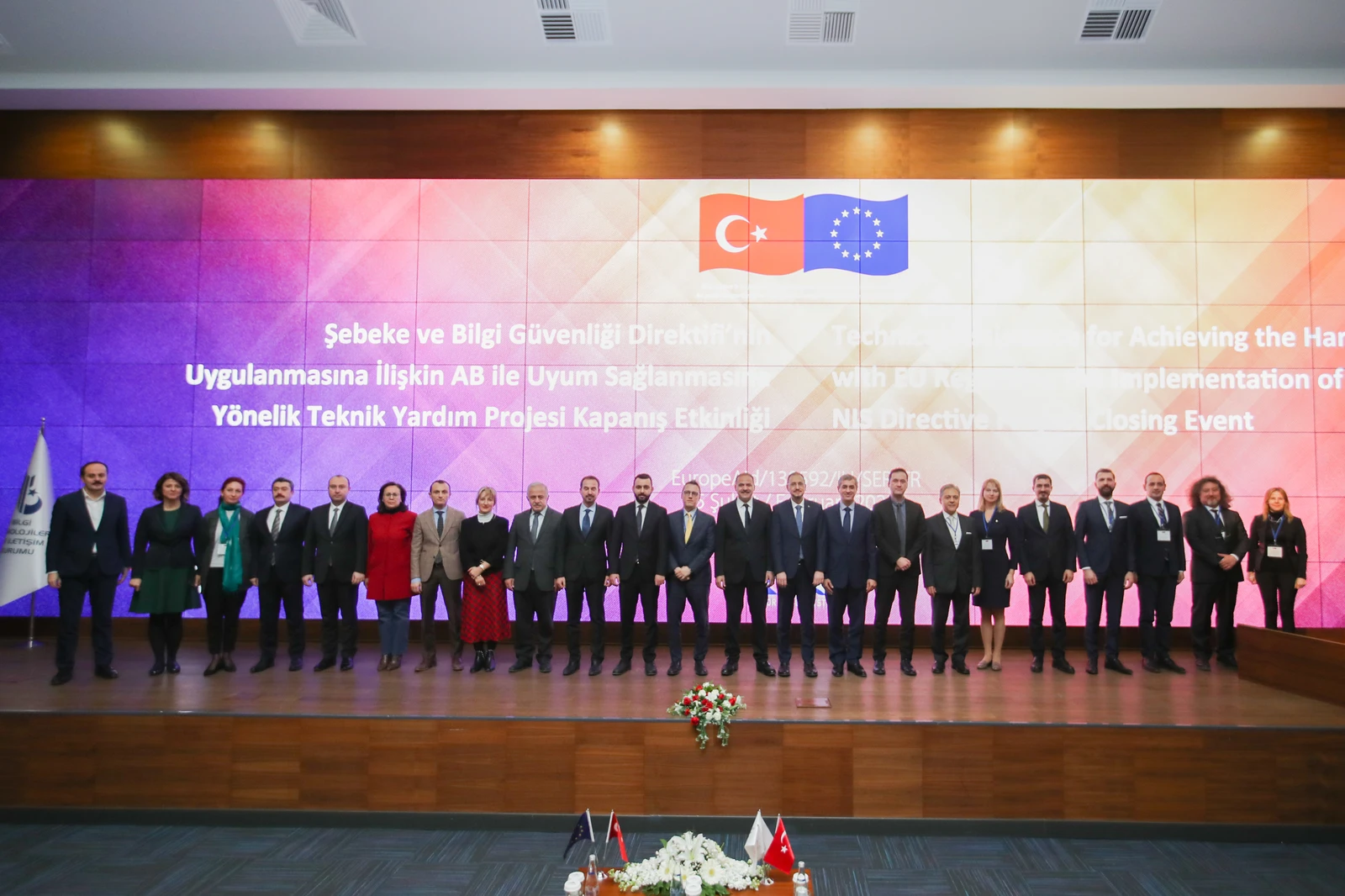
Information Technologies and Communication Authority hosted the Closing Event of the Technical Assistance Project for Harmonization with the EU Regarding the Implementation of the Network and Information Security Directive.
Speaking at the closing meeting of the project, Dr. Ömer Fatih Sayan, Deputy Minister of the Ministry of Transport and Infrastructure, stated that one of the most priority issues of today is the digital economy. Noting that the digital economy affects all sectors, especially industry, transportation, health, and agriculture, Sayan expressed that it is necessary to disseminate information and communication technologies in all sectors to provide new and differentiated digital services and to reap the fruits of the digital economy on a global scale.
Emphasizing the need to focus on providing next-generation technological infrastructures and innovative services with high quality, Sayan said, “Especially with the transition to 5G, considering that the amount of data usage will increase further with next-generation smart devices and applications; high-speed and high-capacity technologies will be needed from the backbone network to the access network, especially in mobile broadband communication infrastructures. In addition, with the start of 6G studies and the increase in value-added services in the near future, the capacity need will increase even more. Therefore, there will be a greater need for infrastructure investments in the communications sector, and increasing these investments and planning them with an innovative approach will become one of the most important issues of the coming years.”
Deputy Minister Sayan: Success in Cybersecurity Belongs to All of Us
Touching upon the work done in the field of cybersecurity, Sayan said, “Our country has surpassed countries like Germany, Denmark, and Italy in the ITU Cybersecurity Index and rose to the 11th place in Europe. Globally, it rose from 43rd to 20th among 175 countries. This great success belongs to all of us. In addition, regulations based on international information security standards are being made in the field of network and information security, and operators are supervised within the framework of these regulations. In this area, in addition to the works of international standardization organizations, regulations made in other countries are also followed, and our national legislation and practices are updated when necessary.”
President Karagözoğlu: We See Cybersecurity as Part of Our National Security
Ömer Abdullah Karagözoğlu, President of the Information Technologies and Communication Authority, also attended the program. Speaking about the importance of information and communication technologies, Karagözoğlu said, “While technology makes our lives easier on one hand, on the other hand, it has made the risks arising from these technologies a part of daily life. As individuals, companies, critical infrastructures, and states face serious cyber threats, cyber attacks are increasing day by day. Therefore, allocating more resources to combat cyber incidents is becoming an important issue.”
Emphasizing the importance of ensuring cybersecurity at this point, Karagözoğlu said, “We see cybersecurity as part of our national security due to the risks that negatively affect social and economic life. Unfortunately, in today's cyber world, it is not possible to ensure absolute security. Nevertheless, we believe that there are works that need to be done to increase our cybersecurity level and preparedness.”
Also touching upon the importance given to collaborations in the field of cybersecurity, Karagözoğlu shared the following information: “I think these collaborations will make great contributions to making our countries' cyber spaces more secure. While mentioning the importance of international cooperation, I find it beneficial to mention the Pre-Accession Instrument, one of the most important tools in providing this cooperation. Turkey's EU harmonization studies are financed under the 'Regulatory Reform and Acquis Alignment Mechanism' within the Democracy and Governance sector of IPA II. The RRAA 2014 programming studies are carried out under the coordination of the EU Ministry. The Technical Assistance Project for Harmonization with the EU Regarding the Implementation of the Network and Information Security Directive, from which our institution benefits, is also within this scope.”
Emphasizing that significant gains have been achieved in determining the updates that need to be made in our country's legislation and practices by analyzing international practices in the field of network and information security, Karagözoğlu stated, “When we examine world practices in the field of network and information security, we see that they are based on basic principles such as identifying critical sectors, making security regulations by competent institutions in these sectors towards operators providing critical services, notifying cyber incidents detected by service providers to national cyber incident response teams, and carrying out necessary procedures in coordination. We can say that this structure and practices largely overlap with those in our country. However, critical sectors and regulatory needs in these sectors also differ according to country-specific conditions.”