




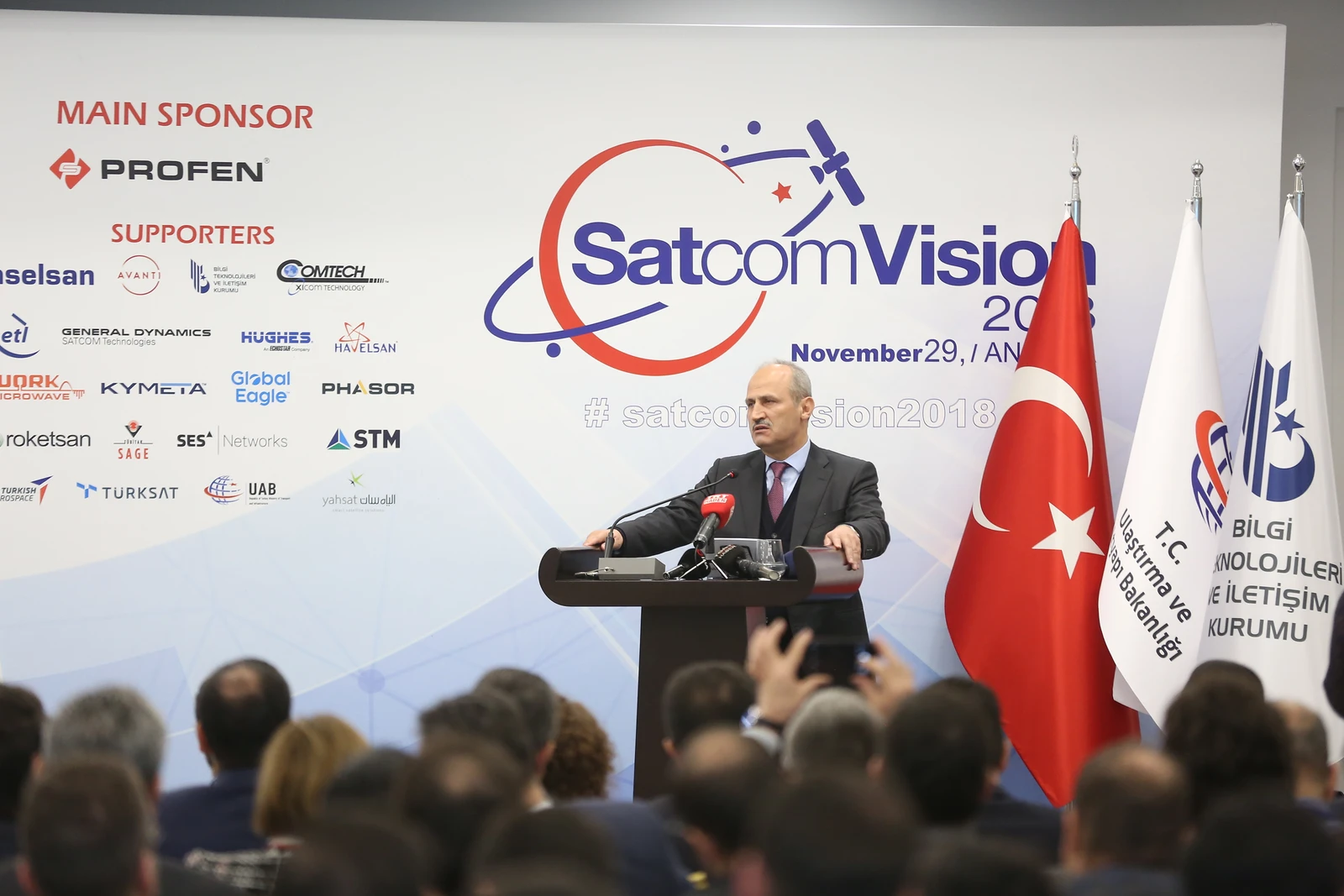
Satcom Vision 2018 discussed the development of satellite technologies.
Information Technologies and Communication Authority hosted the program, which was attended by Minister of Transport and Infrastructure Mehmet Cahit Turhan, Deputy Minister of Transport and Infrastructure Dr. Ömer Fatih Sayan, BTK President Ömer Abdullah Karagözoğlu, TÜRKSAT General Manager Cenk Şen, sector representatives, and foreign guests.
Minister Turhan: Our Ultimate Goal is to Produce Satellites with Domestic and National Technology
Minister of Transport and Infrastructure Mehmet Cahit Turhan spoke at the opening of the program. Turhan emphasized that although satellite technologies are a highly complex technology emerging from the combination of intricate elements, they have turned into a competitive field engaged by many countries over time. Drawing attention to the important steps Turkey has taken to become one of the actors in global satellite services, Turhan said, “With the Türksat 5B satellite, especially the Ka-band capacity will increase 15 times the current capacity. With the planned Ka-band capacity on the Türksat 5B communication satellite, we will particularly focus on the commercial ships and airlines market.”
Stating that the supply of satellite capacity offered to the sector has increased and that technological developments in the near future will raise the demand for satellite capacity, Turhan said, “We plan to complete the project that will place Turkey among the 10 countries capable of producing communication satellites in 2020. Under all circumstances, our ultimate goal is to enable Turkey to join the ranks of countries that can produce satellites with domestic and national technology, launch satellites, and take a high share from the global satellite market. We will achieve these in the near future.”
Deputy Minister Sayan: We Will Add New Ones to the Satellite Sector on the Path to a Strong Turkey
Deputy Minister of Transport and Infrastructure Dr. Ömer Fatih Sayan also highlighted the developments over the last 16 years. Noting that satellite technologies carry high risk in addition to being an advanced technology, Sayan said, “Satellite technology provides very important contributions in the fields of communication, navigation, and monitoring the world. Satellite technologies provide countries with significant advantages in political, strategic, military, technological, and economic areas worldwide. For this very reason, our country continues its projects to increase its capacity and competitiveness in the satellite sector in order to fully benefit from these contributions. On the path to a strong Turkey, we are striving to add new steps in the satellite sector to the major steps we have taken.”
Emphasizing that upon completion of the National Ground Station Development Project (MİYEG), Turkey will reach the level of realizing all elements of a satellite system from ground station to satellite, Sayan said, “TÜRKSAT 6A, Turkey's first communication satellite whose design, tests, and integration are 100% domestic and many of whose sub-components are produced domestically at the facilities in Kahramankazan, will be ready to become operational in 2021. Our 5A and 5B satellites will provide us with the opportunity to broadcast satellites over a wider area worldwide. We aim to launch TÜRKSAT 5A, God willing, in 2020, and TÜRKSAT 5B in 2021. Considering the changes in the satellite technologies field worldwide, I want to emphasize that Turkey must definitely take its place in these global developments. There is only one way to do this. To expand the boundaries of our service and working areas. For this reason, one of our biggest goals is to make TÜRKSAT one of the top 10 operators worldwide.”
President Karagözoğlu: As BTK, We Do Not Hesitate to Put Our Hands Under the Stone
BTK President Ömer Abdullah Karagözoğlu, who spoke at the opening of the program, began his speech by stating that satellite technologies are an indispensable service of the developing world today.
Referring to the studies conducted in this field, Karagözoğlu said, “As BTK, in order to widespread the use of satellite communication systems in our country, to ensure domestic R&D and services by operators, to facilitate marketing activities so that they can offer their services to wider audiences, to provide high-speed Internet connection at more reasonable prices in regions where cable access is not possible, to provide a fair competitive environment for satellite operators, and to ensure that subscribers receive quality service at affordable prices, we have abolished some satellite radio license and usage fees in the Radio Fee Tariff attached to Law No. 5809 on Electronic Communications and reduced the financial obligations on operators to the minimum possible level.”
Stating that BTK is also conducting studies regarding authorization regulations, Karagözoğlu said, “Within the framework of these regulations, the number of authorized operators for Satellite Communication Service, which is provided via satellites, satellite ground stations, or satellite terminals, has reached 32 recently, while the number of subscribers using this service is 12,295. In the Satellite Platform Service, known in the public as the transmission of pay TV broadcasts via satellite, the number of authorized operators is 12, while the number of users approaches 4.5 million. In GMPCS regarding mobile phone service via satellites, the number of authorized operators is 11, while the number of subscribers is 6,586. In the coming period, we continue our studies in areas such as reaching wider subscriber bases for these services. In line with our President's vision and targets, and under the guidance of our Minister, as BTK, we do not hesitate to put our hands under the stone in developing satellite technologies and their infrastructure, and we strive to make regulations that address as many stakeholders as possible to support the sector,” concluding his speech.