




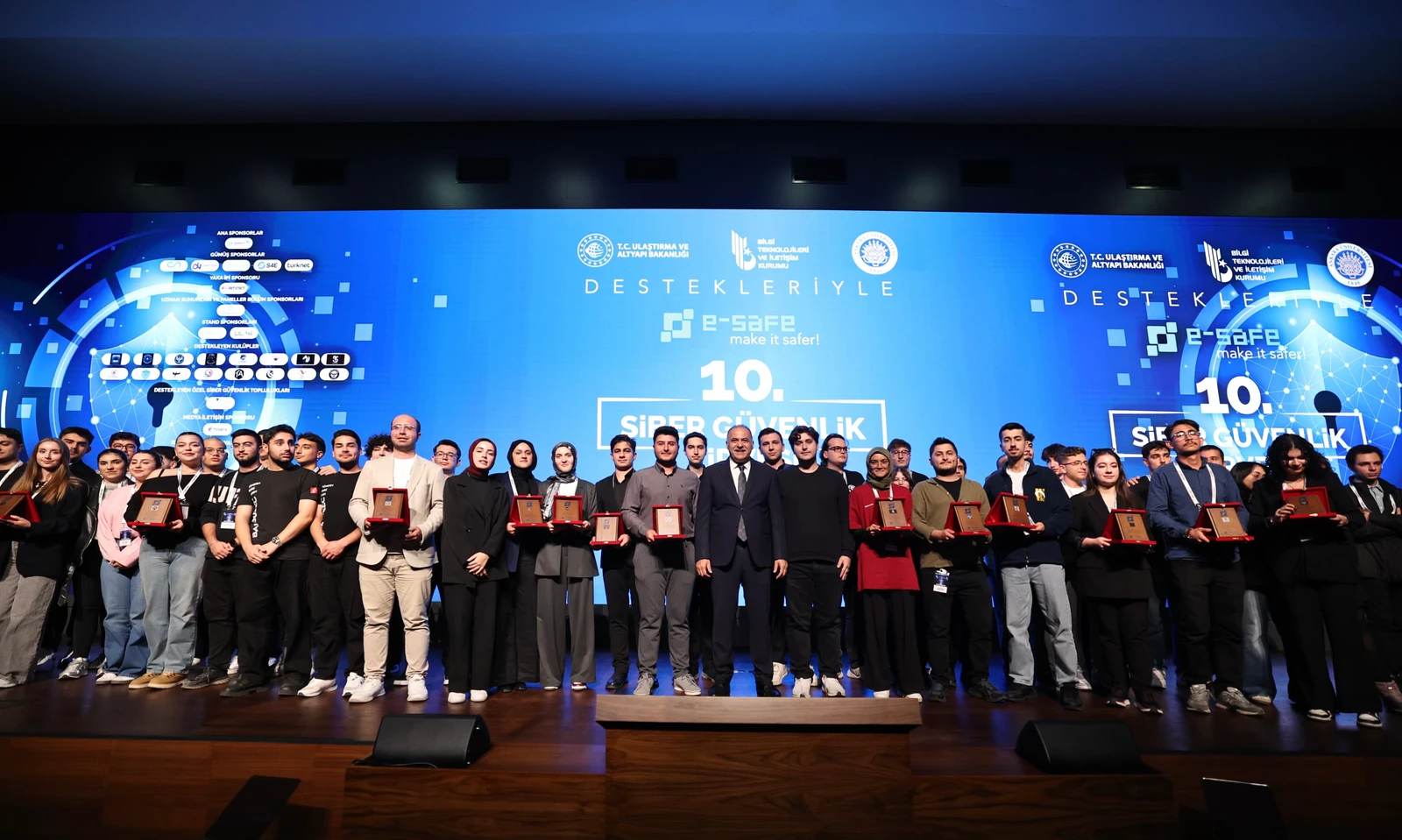
The 10th e-Safe Cybersecurity Summit, organized under the leadership of e-Safe this year, was hosted by the Information Technologies and Communication Authority.
At the opening of the summit, whose theme this year is "Careers in Cybersecurity," Dr. Ömer Fatih Sayan, Deputy Minister of Transport and Infrastructure, delivered important messages in the field of cybersecurity.
Stating that cybersecurity has now become an indispensable part of daily life, Sayan said, "Imagine waking up one morning to find that the electricity is out and you cannot access the banking system. This is not just a movie scenario; it is a risk that could turn into reality."
Reminding that more than 97 billion cyber attack attempts were recorded worldwide last year alone, Sayan said, "If cybercrimes were a country, it would be one of the world's largest economies."
Sharing the information that nearly 1.5 million cyber attacks were detected in Türkiye in 2024, Sayan stated, "Our country's cyber fortress, the National Cyber Incident Response Center (USOM), is on duty 24/7. With domestic and national software such as KASIRGA, AVCI, AZAD, ATMACA, and KULE, whose value is expressed in millions of dollars, we ensure that threats are detected and prevented with minimal cost, in the shortest time, and with a proactive approach. As long as we are at the helm of our duty, we will continue our activities with determination."
Deputy Minister Sayan: Remaining Dependent on Foreign Sources in Cybersecurity Leaves the Door Open to Security Vulnerabilities
Emphasizing the importance of domestic and national technologies in his speech, Sayan said, "Just as we achieved independence in the skies by producing our own UAVs and SİHAs in the defense industry; in cybersecurity, we must also be independent in the digital world with our own software."
Reminding that recently the BTK authorized IoT communication services over low Earth orbit satellites for the first time in Türkiye, Sayan stated that this development is a strategic step in terms of Türkiye's digital independence and space vision.
Touching upon the 2024-2028 National Cybersecurity Strategy and Action Plan, Sayan said, "This plan is not just a document; it is Türkiye's digital security roadmap. Protecting critical infrastructure, strengthening human resources, developing domestic technologies, and increasing international cooperation are among our main goals."
Noting that works are now being carried out from a single hand thanks to the Cybersecurity Presidency established by the Presidential Decree, Sayan said, "Our new structure strengthens harmony between institutions and makes our future-oriented steps more planned."
Stating that the fight has gained a much more institutional ground with the Cybersecurity Law that entered into force on March 19, 2025, Sayan said, "All these steps are the result of years of experience, precautions, and determination."
Sayan concluded his speech with the words, "The steps we have taken are not only on paper but also appreciated on a global scale. Türkiye is steadily advancing to a position that is cited as an example in its region."
President Karagözoğlu: We Are Working with Determination for a Secure and Sustainable Cyber Ecosystem
Ömer Abdullah Karagözoğlu, President of the Information Technologies and Communication Authority, emphasized that they are working with determination to build a secure, resilient, and sustainable cyber ecosystem in Türkiye's digital transformation process.
President Karagözoğlu said, "In the face of increasingly diversifying cyber attacks, to sustain our fight strongly, we are strengthening both our software infrastructure and human resources, and with our investments in domestic and national technologies, we are turning cybersecurity not only into a passive defense line but also into an active deterrence mechanism."
Addressing the youth in his speech, Karagözoğlu said, "If we want to build a strong society in cybersecurity, we need to strengthen the role of every stakeholder and increase cooperation. That is exactly why we are here today. Consumers, producers, universities, media, civil society organizations, and public decision-makers. We are all links in the same chain. We are all part of this ecosystem. As a country, our goal is not only to defend against threats but also to become a producer and guiding country in cybersecurity. While increasing the number of our domestic and national solutions, supporting the cyber heroes of the future is also among our top priorities."