




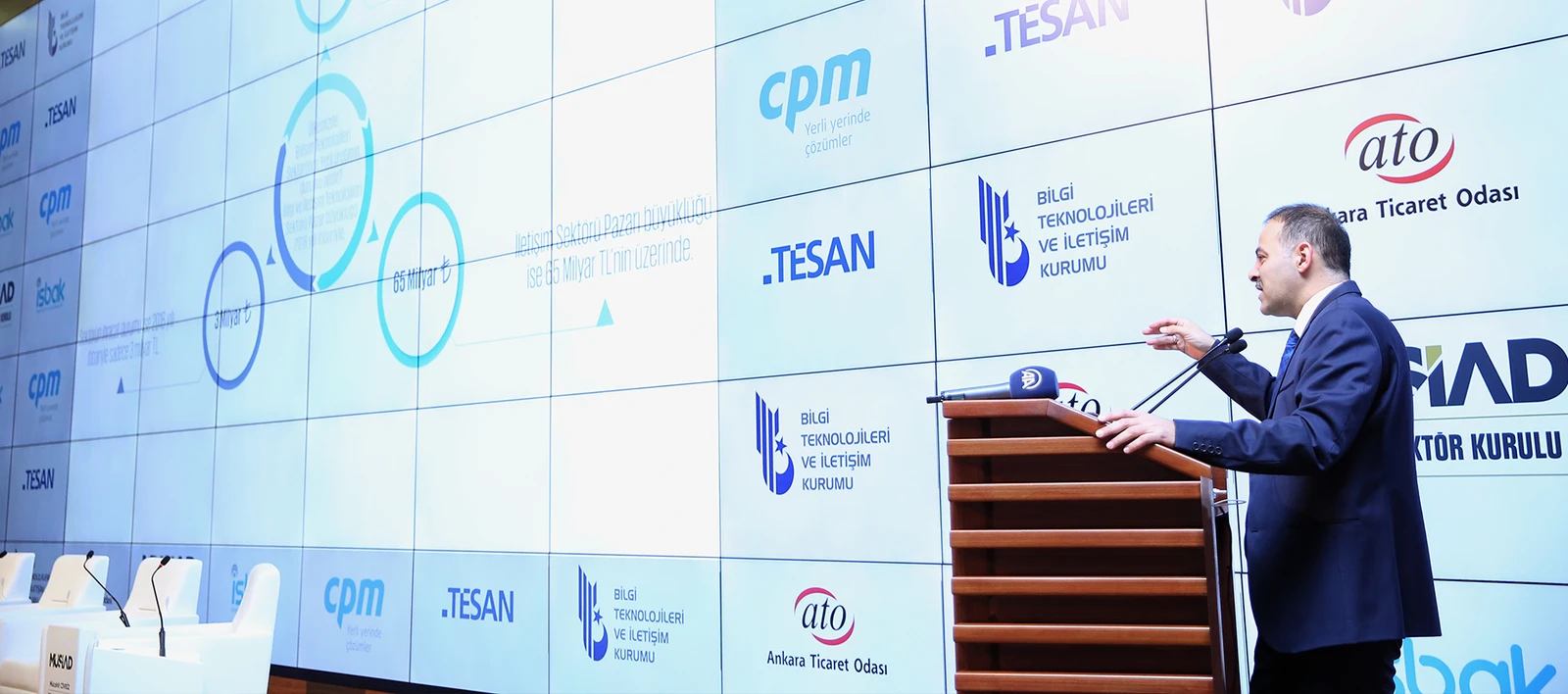
BTK President Dr. Ömer Fatih Sayan, speaking at the consultation meeting themed ‘The Role of the Public in the Development of Domestic Information Technologies,’ said, “To rank at the top in global competition, it is an indispensable necessity to be the first to develop and implement the newest technologies.”
The consultation meeting themed “The Role of the Public in the Development of Domestic Information Technologies,” organized by MÜSİAD Information Sector Board and MÜSİAD Ankara, was held at BTK premises. Participants included MÜSİAD Ankara Branch President İlhan Erdal, MÜSİAD Information Sector Board President Fahrettin Oylum, AK Party Bolu MP Ali Ercoşkun, BTK Board Member Musa Şahin, and representatives from the Information and Communication Technologies sector.
At the beginning of his speech, Sayan expressed his pleasure at being part of the meeting titled “The Role of the Public in the Development of Domestic Information Technologies,” organized by the MÜSİAD Information Sector Board and hosted by MÜSİAD Ankara Branch and BTK.
WE MUST BE THE FIRST TO DEVELOP AND IMPLEMENT NEW TECHNOLOGIES
Stating that we are living in the golden age of information technologies, Sayan said, “The gains obtained from here are closely related to the success in forming qualified human resources and, as a result, the power and prestige of countries until the stage where knowledge turns into products. It would not be wrong to say that states successful in this progress process are effective and influential on a global scale. Countries' advancement in technology helps them become more independent and free, perhaps even more fearless, in their domestic and foreign actions. To rank at the top in global competition, being the first to develop and implement the newest technologies is an indispensable necessity. If our ultimate goal is in this direction, we need to put innovation, research, development, and entrepreneurship on our agenda. By closely following and effectively using information and communication technologies, we can increase efficiency in our industries and achieve economic growth.”
PRODUCTIVITY CAN BE INCREASED BY EFFECTIVELY USING ICT PRODUCTS
Indicating that we can increase efficiency in our industries by effectively using Information and Communication Technologies, Sayan stated, “However, this is not enough. We must also be able to develop Information and Communication Technologies, design ICT products, produce them, and sell them in world markets. If we are to create a developed and prosperous country, we need to take a more reasonable slice of this big pie. First of all, the public can support R&D, innovation, and domestic production/design not only in ICT but in all industries through general education and industrial policies. I want to emphasize that our governments have supported innovation and R&D activities with the policies they have pursued since the past. As a result of our governments' great efforts, the number of full-time R&D personnel, which was around 38 thousand in 2003, increased 3.5 times to approximately 137 thousand in 2016. Similarly, in the ICT sector, which employs about 120 thousand people as of 2016, the number of full-time R&D personnel is estimated to be around 18 thousand, which is 15% of total employment.”
ULAK: THE BEST EXAMPLE OF DOMESTICITY IN PUBLIC R&D ACTIVITIES
Emphasizing that the public can actively participate and even lead in R&D activities in collaboration with private companies, Sayan said, “One of the best examples of this is the ULAK Project. With the ULAK Project, it was planned to develop a domestic and national base station in 4.5G technology. The works initiated in 2013 by our Ministry and the Undersecretariat for Defense Industries with the consortium of Aselsan, Netaş, and Argela have now begun to bear fruit. Today, the first tests of the ULAK base station have been conducted, and the first video call has been made with these stations. In addition, under universal service, the use of these national base stations is on the agenda to establish 4.5G infrastructure in rural settlements with populations between 1-500. Insha'Allah, the ULAK project will serve as a step in producing all infrastructure technologies needed in mobile communications with domestic and national means. Additionally, it will make a significant contribution to reducing our country's current account deficit in the long term. Another duty of the public in developing domestic and national products is to intervene in the process through regulations where it cannot be involved in the production process. In other words, to encourage the design and use of domestic and national products through regulations.”
WE HAVE STRIVED FOR THE USE OF DOMESTIC AND NATIONAL RESOURCES IN INVESTMENTS
Explaining that as the Information Technologies and Communication Authority, they have strived since the 4.5G authorization preparation works to meet the hardware and software in the electronic communications sector with domestic and national means in line with the 2023 targets, Sayan said: “In the 4.5G authorization, we imposed on the operators the obligation to procure at least 30% of total software and hardware investments related to the network from domestically certified products in the first year, at least 40% in the second year, and at least 45% in the third year and beyond, and additionally at least 10% from products produced in Turkey by SMEs in Turkey. We are aware that to achieve success in Domestic and National Information Technologies in our country, innovations must be followed in all sectors. For this purpose, we need to think about and consider factors such as encouraging the use of innovations in the information sector in the economy, legal infrastructure of the information society, measures to encourage entrepreneurship, preparations for quality education and all kinds of infrastructure oriented towards knowledge and learning, effective and competitive information and communication service tools needed by society, research centers for creating products and services suitable for new technological developments, new ways of doing business, and more.”
WE SHOULD SET OUT WITH MACRO PLANNING
Speaking on the progress of domestic production in the information technologies sector, Sayan shared the following information: “As of 2016, the market size of the Information and Communication Technologies Sector; Information Technologies Market is 30 Billion TL, Communication Sector Market size is over 65 Billion TL. The sector's export status is only 3 billion TL as of 2016. These figures show us that the Information Technologies Sector creates great opportunities for our country, and that we are just at the beginning of the road to create a revenue-generating and employment-oriented sector. In this context, we need to make more progress in this field and see the headings affecting the process to reach the goal. For this, we should set out with Macro Planning.”
ENSURING NATIONAL CYBER SECURITY IS OUR DUTY
Expressing that every step taken by the public to support domestic and national production in the information and communication sector is as important for the effective and efficient use of national resources as for national security, Sayan said, “While our Institution fulfills its regulatory duties towards the electronic communications sector in our country on one hand, it continues its activities to ensure national cyber security as per the duties and responsibilities assigned to it on the other hand. In this context, USOM, established within our Institution and operating since 2013, continues to perform important functions for the development of our country's cyber security ecosystem. I think we will hear about USOM more frequently with its successful works in the future.”
Emphasizing that this consultation meeting will shed light on the missing issues regarding the development of Domestic Information Technologies to achieve the target in Information Technologies as a country, and that BTK will always fulfill its duty within the framework of the results obtained, Sayan concluded his speech by wishing that the MÜSİAD Information Sector Board would be an occasion for similar events in the coming periods.
MÜSİAD Ankara Branch President İlhan Erdal, who also spoke at the meeting, reminded that on the night of July 15, the fate of the country changed with a phone traffic using communication infrastructures. Erdal stated that today, in a period where the information sector talks about Industry 4.0, unmanned aerial vehicles are used in defense industry, and artificial intelligence is on the agenda, Turkey cannot neglect such a sector. Touching on domestic production, domestic goods, and public consumption of domestic products, which are constantly emphasized but never progressed as desired, Erdal said, “Developed companies are preferred, and emerging domestic brands and companies are not supported enough. Without public support, progress in the private sector is impossible. We need to bring this important issue to the level of developed countries with public support. From now on, as MÜSİAD, we will follow up on the issue, request support from relevant institutions, and grow our domestic brands together.”
MÜSİAD Information Sector Board President Fahrettin Oylum stated that more than 300 board members operating in the information sector add value to Turkey with domestic and national products in areas such as satellites, communications, smart cities, big data, and network security. Touching on Turkey's significant momentum in information technologies over the last 15 years, Oylum expressed that the country has transitioned from the class of technology-consuming countries to the class of technology-developing countries.