



Information Technologies and Communications Authority and Saudi Communications and Information Technology Commission Signed a Memorandum of Understanding.
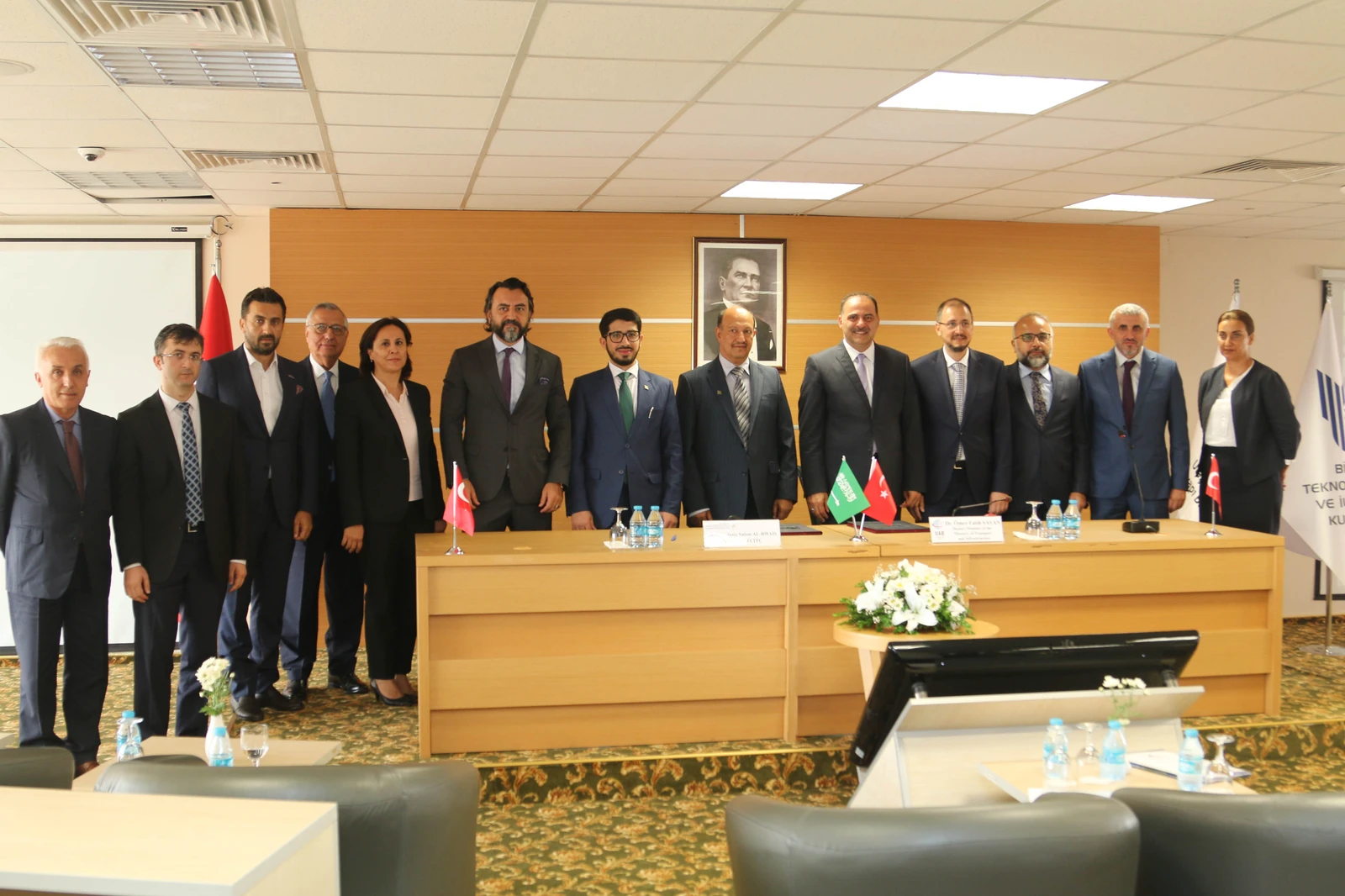
The signing ceremony of the Memorandum of Understanding, organized to enhance cooperation between the two countries in the field of communications and information technologies, was attended by Deputy Minister of Transport and Infrastructure Dr. Ömer Fatih Sayan, President of the Information Technologies and Communications Authority Ömer Abdullah Karagözoğlu, CITC President Dr. Abdulaziz Bin Salem AL Ruwaıs, and guests.
In his speech, Ömer Abdullah Karagözoğlu, President of the Information Technologies and Communications Authority, who emphasized the existence of a common understanding between Saudi Arabia and Turkey on most points, said, “I hope that this event will be a meaningful first step towards establishing a new framework of cooperation in the field of information technologies. Especially considering the innovations in the last ten years, information and communication technologies have become one of the fastest-growing and most important sectors. As it is known, we are living in the age of digital transformation. This transformation not only changes the interaction between people but also affects the interaction between people and governments, and governments among themselves. Since digital transformation plays a vital role under the headings of transparency and reliability by creating new business opportunities in facilitating access to information and supporting economic growth, countries that clearly understand this transformation and manage the process wisely will have an advantage compared to others.”
President Karagözoğlu: We Are Aware of the Importance of Cooperation with Our Counterparts
Stating that in today's world, as individuals, businesses, and governments become increasingly interconnected, international cooperation gains greater importance, Karagözoğlu said, “As BTK, we are aware of the importance of mutual cooperation with our counterparts. For this reason, we attach great importance to the partnership we will initiate here today with our esteemed Saudi counterparts. As the first institution in Turkey to assume the regulatory authority role for the sector, I am proud to state that BTK has gained considerable expertise and experience throughout its 18-year activity period since its establishment and has always adopted a constructive attitude in sharing this accumulation by creating a dialogue atmosphere between countries. In this regard, we plan to expand and deepen our partnership with our counterpart institutions and counterparts in the future. Especially since 2003, electronic communication services, which play an important role in the development of the basic components of the informatics sector and the new economy in Turkey, have made significant progress. In addition, with our projects and activities carried out during this period, mobile communication, fiber infrastructure, broadband internet, and many other services have reached a level that can compete with the world.”
Karagözoğlu also shared some figures on the subject: “While the number of mobile subscribers reached approximately 79 million, the number of mobile subscribers preferring 4.5G reached approximately 67 million. Considering that the 4.5G service was offered to consumers in April 2016, it is pleasing to see that 4.5G has spread comprehensively within 2 years. The fastest-growing service area in our country is broadband internet services. Influenced by the success of 4.5G, the total number of broadband internet subscribers reached 70 million. In addition, there are 12.3 million fixed subscribers and 57.7 million mobile phone subscribers. There are 11.5 million fixed telephone subscribers with a penetration rate of 14.2%. With the development of fiber infrastructure in our country, fiber internet subscriptions are increasing rapidly. The number of internet subscribers over fiber infrastructure has reached 2.5 million.”
Reminding that as Turkey's regulatory authority in the field of information and communication technologies, the memorandum of understanding to be signed today with the Saudi Communications and Information Technology Commission will create a strong ground for close cooperation between private sector stakeholders operating in the ICT field and the regulatory institutions of both countries, Karagözoğlu said, “I believe that with our efforts and dedication, BTK and the Saudi Communications and Information Technology Commission will achieve more together, and the relationship between the two institutions will develop and strengthen. On this occasion, I would like to thank Dr. Abdulaziz Bin Salem AL RUWAIS and his colleagues for their cooperation and look forward to the fruitful results of the activities we will carry out together,” concluding his speech.
Deputy Minister Sayan: Turkey is Aware of the Economic Impact of ICT
Expressing that as two important countries of the region and the Islamic world, Turkey and Saudi Arabia have always acted in line with mutual respect and common interests, Deputy Minister of Transport and Infrastructure Dr. Ömer Fatih Sayan stated, “The information and communication technologies sector has become an important part of the economy, especially in daily and social life. Information and communication technologies continue to affect businesses and value chains in various sectors. Turkey is aware that information and communication technologies will have a much greater impact on our economy in the near future. We have a rapidly growing ICT market. The Turkish ICT market has reached 120 billion TL. As you know, Turkey is continuing its membership negotiations with the European Union (EU). We have deep cooperation and partnership relations with the EU. Therefore, we attach utmost importance to aligning the electronic communication and communication sector with EU legislation. Because we believe that EU laws will make a significant contribution to creating a competitive and solid ICT sector for us. We have taken very important steps on this path. In short, our harmonization process with the EU is accelerating both in transport and communication sectors. In this context, Turkey also benefits from EU Financial Cooperation and implements important projects. The efforts we carry out in many areas are in the same direction as the European Union's ‘Digital Agenda’ headings.”
Stating that we will step into a new era with “5G and Beyond,” Sayan said, “We have set the vision to be one of the first countries to use 5G and beyond technologies. In addition, we aim to create Turkey's 5G and beyond technologies with domestic and national designs and products to the widest extent possible. In order to accelerate ‘5G and Beyond’ studies in Turkey, we established the ‘New Generation Mobile Communication Technologies Turkey Forum,’ also known as 5GTR Forum, two years ago. 5GTR Forum brings together Turkey's leading academics, R&D companies, manufacturers, and operators. 5GTR Forum will also serve vertical sectors that will use 5G products and services to utilize the ICT sector. Working groups for Core Network, Physical Network, Services and Applications, and Standardization were established under the 5GTR Forum organization structure, and the 5GTR Forum events were made efficient in a short time. These working groups prepared the ‘5G and Beyond White Paper,’ including roadmaps for our country and 5G priorities.”
Continuing his speech, Sayan said, “In addition, an open test field called 5G Valley has been established in Ankara under the leadership of BTK. Turkey's three mobile operators and the top 3 universities in Ankara joined forces to establish this test field. This test field will be open to all researchers and developers. Thus, we are trying to create a suitable environment for everyone who dreams of 5G and beyond. This can also be considered a good example showing how universities and industry can work together. The 5G Valley Open Test Field is conducting studies for the establishment of the ‘5G and Beyond Joint Graduate Program.’ Contributions will be made to the training of qualified human resources needed by our country in the short, medium, and long term in 5G and beyond between universities and disciplines. The program aims to produce sustainable competence in advanced communication technologies and to produce outputs in various forms such as patents, projects, articles, companies, and theses.”
Following the speeches, the signing ceremony between the authorities of the two countries took place.