




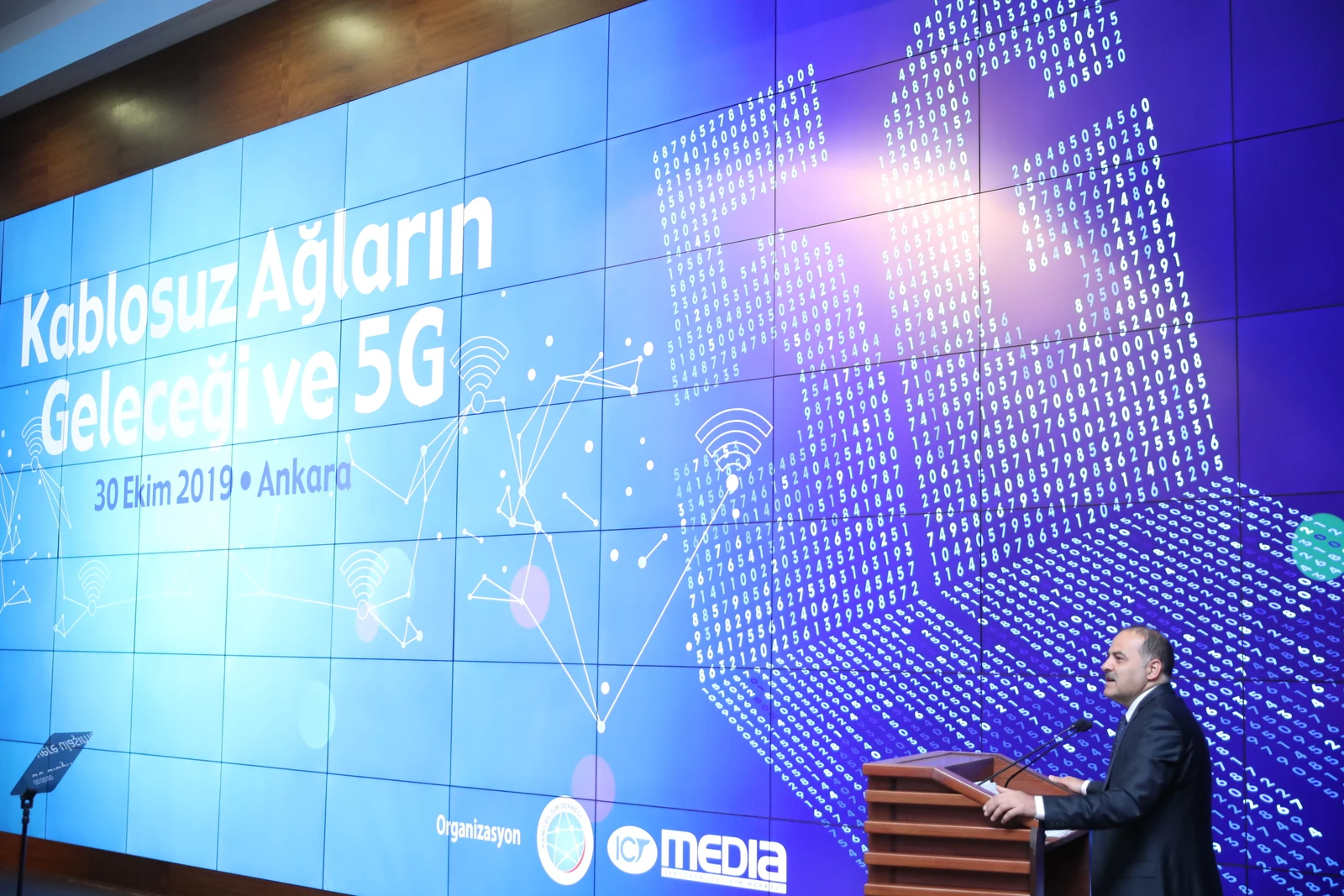
Public Informatics Association and ICT Media, in collaboration with the Information Technologies and Communication Authority hosting, organized the event titled "The Future of Wireless Networks and 5G".
The program was attended by the Deputy Minister of the Ministry of Transport and Infrastructure Dr. Ömer Fatih Sayan, the President of the Information Technologies and Communication Authority Ömer Abdullah Karagözoğlu, the Vice President of the Public Informatics Association Yakup Şıvka, ICT Media General Publication Manager Murat Pehlivan, and numerous sector representatives.
In his opening speech at the event, the Deputy Minister of MoTI Dr. Ömer Fatih Sayan drew attention to the fact that cyber attacks targeting Turkey mostly aim at the electronic communication infrastructure and, primarily public institutions, as well as critical sectors such as banking, energy, and health.
Sayan stated, "99% of these attacks consist of distributed denial-of-service (DDoS) and phishing attacks. In recent days, particularly intense DDoS attacks were carried out against the banking sector. In the building we are in, under the coordination of our National Cyber Incident Response Center (USOM), we conducted the necessary work together with internet service providers and relevant banks 7/24."
Sayan also spoke about the details of the attacks carried out against the banking sector over the weekend. Noting that it was conducted as a DDoS attack aimed at taking down the services of a specific institution, Sayan said, "Although information related to this attack campaign was first announced by the relevant bank's statement on the night of Sunday, October 27, the first wave of attacks had actually started earlier. The attack in question began on Saturday, October 26, but were attacks that did not have the capability to affect the services received by our citizens. More precisely, these attacks were neutralized very quickly by defense systems. The second wave of DDoS attacks began on Sunday and continued for about one and a half days, increasing in intensity. During this period, various types of attack vectors were used intensively together."
Deputy Minister Sayan: Cyber Attacks Increased Approximately 2-Fold
Sharing the data on attacks reported to USOM by operators as of September this year, Sayan said, "In 2019, more than 95 thousand attacks were carried out against Turkey. We see that the reported cyber attacks this year have increased approximately 2-fold compared to the same period of the previous year. For the cyber security of our country, we are fighting against cyber attacks targeting our country 7/24 through USOM operating under the BTK. Especially after the attacks that affected internet services at the end of 2015 in our country, we ensured that our operators make significant investments. We do not find it appropriate to share numerical information at this point, but I want to emphasize that we have multiplied the DDoS prevention capacity. Turkey has become a difficult target in terms of cyber security."
Stating that software developed entirely with domestic and national resources, based on machine learning and artificial intelligence technologies, is used in the fight against cyber threats, Sayan announced that they aim to eliminate cyber security dangers at their source before they even emerge.
Deputy Minister Sayan: We Will Open the Test Field in Istanbul
Reminding that the 5G Valley Open Test Field Project is being carried out under the coordination of BTK, Sayan said, "We have established the 5G Valley Open Test Field in Ankara in collaboration with Hacettepe University, İhsan Doğramacı Bilkent University, Middle East Technical University (METU), Türk Telekom, Turkcell, and Vodafone, and tests are being conducted here. We will determine the area for the test field in Istanbul together with Istanbul Technical University, Yıldız Technical University, Boğaziçi University, Istanbul Cerrahpaşa University, and our operators, and we will hold its official opening in the coming days."
President Karagözoğlu: 5G Technology Will Provide Great Contribution to the Economy
BTK President Ömer Abdullah Karagözoğlu also spoke about the importance of 5G and cyber security in his speech. Emphasizing that world countries are competing for 5G, which is the next version of 4G technology, Karagözoğlu said, “5G is coming to make a radical change in our lives, so to speak. With 5G entering our lives, machine-to-machine communication will reach the highest levels, and we will all witness how data transfer speed increases. In addition, there is no doubt about the great impact that 5G technology will have on the economy. According to estimates, by 2035, goods and services worth trillions of dollars will be traded due to 5G technology, and new employment areas will emerge. On the other hand, this positive economic impact brings along security problems, that is, geopolitical-based threats and certain risks due to the technical features of 5G technology.”
President Karagözoğlu underlined that cyber security is a part of national security and added: “In most countries, cyber space is now seen as a military theater of operations along with land, sea, air, and space. With the developments in the world, we as a country must develop, produce, export, and be self-sufficient domestic and national solutions in the field of information technologies. As the Information Technologies and Communication Authority, we are working both to benefit from the blessings of technology and to protect our country and citizens against possible risks. Especially in the last few years, we are fighting against cyber attacks whose number and complexity are increasing geometrically through USOM, which started operating under BTK. In addition, the Cyber Incident Response Teams established in relevant institutions and organizations, numbering over 1000, and nearly 3000 registered cyber security experts assigned to these teams, continue to protect our country against cyber attacks 7/24 under USOM coordination. USOM, which is gradually becoming a brand, undertakes important tasks for the development of our country's cyber security ecosystem.”
President Karagözoğlu: We Support Domestic National Production by Using Our Own Resources
Touching upon the importance of accessing accurate information when it comes to cyber security, Karagözoğlu said, “As an institution, we support domestic and national production by developing projects worth millions of dollars with our own resources. Within the scope of these studies, AVCI, AZAD, and KASIRGA projects, developed entirely with internal corporate resources, make significant contributions to our national cyber security. While the AVCI application detects malware-infected systems and command-and-control centers, the AZAD application conducts studies to detect slave computers included in BotNets using machine learning and artificial intelligence capabilities. On the other hand, vulnerability scanning of our country's internet-facing resources, especially critical public institutions and critical infrastructures, and monitoring activities for service continuity are carried out with the KASIRGA project. In addition, with the decoy systems we use, not only the detection of attack sources is possible, but also the analysis of attackers' behavior patterns and details related to attacks is enabled.”