

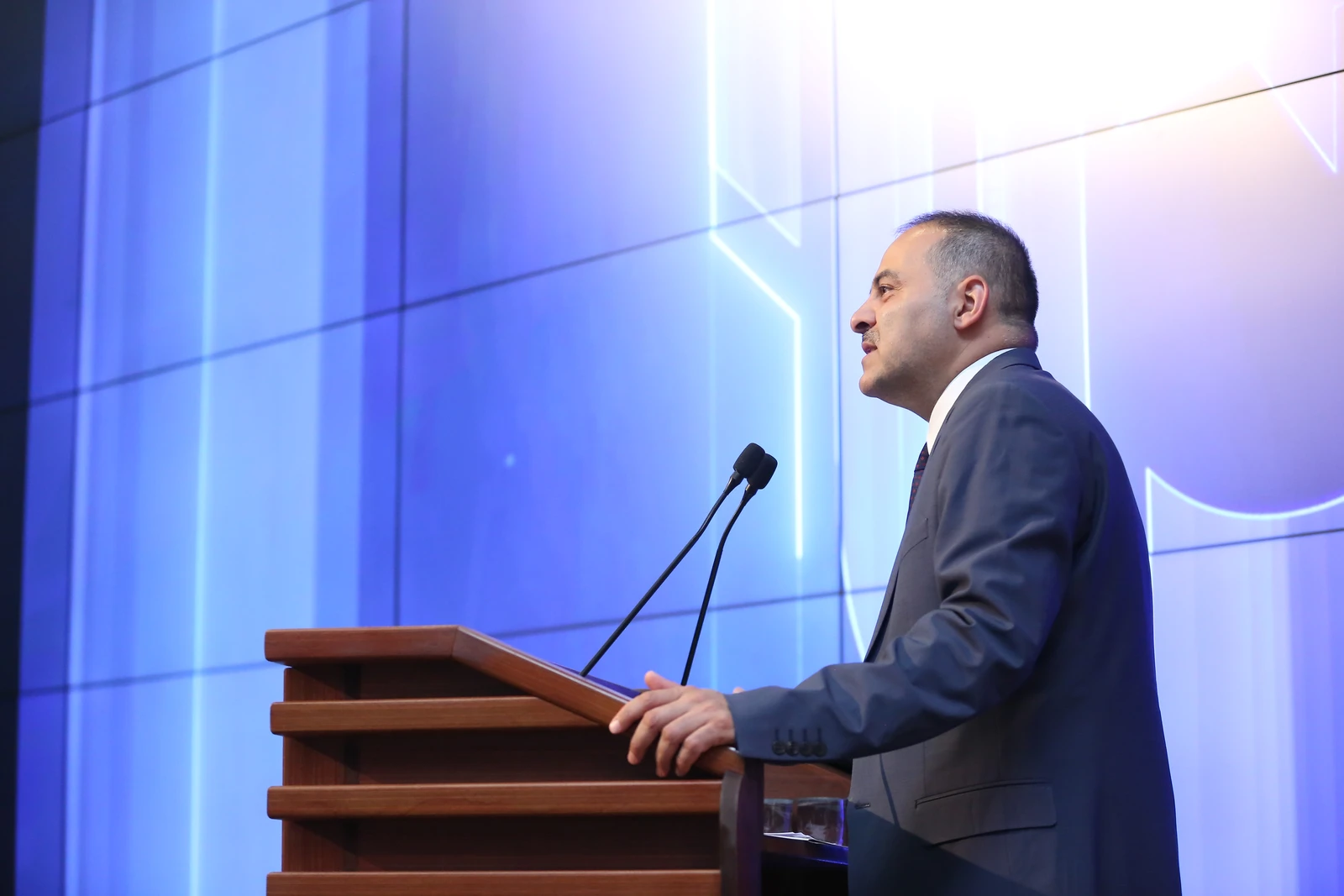
BTK Chairman Dr. Ömer Fatih Sayan spoke at the event organized by TÜBİSAD. In his speech, Chairman Sayan highlighted the transformative power of information technologies.
The “TÜBİSAD Information and Communication Technologies Sector 2017 Market Data” report, prepared for the seventh time this year by the Information Industry Association, and the fifth edition of the "TÜBİSAD Turkey 2017 e-Commerce Market Size" program were held in Istanbul. Dr. Ömer Fatih Sayan, Chairman of the Information Technologies and Communication Authority, who joined via video conference, spoke about the changes in the information technologies field.
Stating that events and phenomena that were once the subject of science fiction movies have now become reality, Sayan said, "In this new era called the 4th Industrial Revolution, we are witnessing profound changes in the global value chain, the emergence of new business and operational models, the convergence of numerous different disciplines through technology, and those who cannot adapt to this change falling behind in the race for development. Undoubtedly, this transformation is not limited to smart, interconnected machines and systems. On the contrary, it will encompass a much broader scope. Dazzling developments are occurring in many areas, from gene sequencing to nanotechnology, from renewable energy to quantum computing. The interaction of these technologies in physical, digital, and biological domains heralds developments on a scale we have never witnessed before.”
Emphasizing that the contributions of information technologies to countries' development, economy, level of prosperity, and education systems are an undeniable fact, Chairman Sayan stated, “The path to being among the countries with high welfare levels undoubtedly passes through producing technology. The most important step on the path to producing technology is to enable the development of used systems and devices with domestic and national resources. This is at the top of the issues we consider most important for our sector. As BTK, we impose various obligations on the operators we authorize to use domestic resources to the maximum extent in their investments. In the 4.5G authorization we conducted in 2015, we imposed obligations on the winning companies to meet a certain portion of their qualified expenditures related to network and communication services hardware and software from products produced by our SMEs in Turkey, and a certain portion from products with domestic goods certificates. The base station produced in the ULAK project has reached a level usable in 4.5G commercial networks, and our operators have placed orders.”
Noting that the total knowledge accumulation is starting to grow geometrically rather than linearly, Sayan said, “For example, monthly mobile data traffic, which was 11 exabytes in 2017, is expected to reach 49 exabytes per month by 2021. Big data is expanding its usage areas every day and opening up new opportunities. Topics such as artificial intelligence, machine learning, robotic applications, and cybersecurity triggered by big data are becoming increasingly important every day.”
5G Will Pave the Way for Entirely New Experiences
Sayan also spoke about 5G. Stating that the high speeds and low latency times brought by 5G will enable much more machine-to-machine communication, Sayan said, “This development will affect artificial intelligence and automation applications, leading to experiences in entirely different dimensions. In the coming years, in many areas we call vertical sectors, from transportation to health, from education to entertainment, we will experience richer content applications that make our lives easier thanks to the capacity increase brought by 5G. As BTK, to be prepared for this process as much as possible with domestic and national resources, we established the 5GTR Forum under the auspices of our Ministry of Transport, Maritime Affairs and Communication. The working groups within the 5GTR Forum are conducting studies to ensure our country plays an effective role in advancing technologies and to determine pioneering topics for our country in 5G and beyond. Instead of being countries that follow technology, to be among the countries that lead and produce technology, we must utilize the opportunities brought by 5G and continuously keep up with development and change.”
Drawing attention to cybersecurity as one of the most important components of the digital age, Sayan said, “As a country, we are taking precautions against these attacks together with the National Cyber Incident Response Center (USOM) established under BTK and our other relevant stakeholders. In cybersecurity, we have strengthened our preventive power with AVCI, AZAD, and KASIRGA software, which are entirely our own products developed with domestic and national resources. The increasing numbers in operational activities are the most important indicator of this. The number of Cyber Incident Response Teams (SOME), which was 544 at the end of 2016, has now reached 933. Until the end of 2018, our studies will continue in areas such as capacity building, taking technological measures, ensuring effective coordination, and protecting critical infrastructure and data to further increase our adequacy in cybersecurity.”
Stating that as the Information Technologies and Communication Authority, they continuously monitor the country's communication sector to facilitate the ongoing process of developments in the information technologies field, Sayan said, “We strive to convert the raw data we receive from the sector into enriched information content and share it with our stakeholders as quickly as possible. In addition to periodic studies such as the Quarterly Market Data Report and the Annual Provincial Statistics Bulletin for this purpose, we continue to fulfill our duty to inform the public with research reports examining new technologies and trends.”
Chairman Sayan also provided the following information in his speech: “As of the end of 2017; the number of authorizations given to operators increased by 4.4% compared to the previous year to 801. Total revenue obtained by operators increased by 12.6% compared to the previous year to 51.1 billion TL. Total investment made by operators increased by 9.8% compared to the previous year to 8.2 billion TL. Mobile subscriber number approached 78 million. 64.6 million of these subscribers switched to 4.5G service that started on April 1, 2016. The number of active 4.5G users exceeded 30 million. Machine-to-machine (M2M) subscriber number, expected to reach a large number in the near future, reached 4.5 million. Fiber infrastructure length increased by 11.6% compared to the previous year at the end of 2017, reaching 325 thousand km. Broadband subscriber number reached approximately 69 million. Approximately 57 million of these subscribers were mobile broadband subscribers, while the rest were fixed broadband subscribers. Mobile broadband usage, which was 0.2 GB monthly in 2010, increased 17-fold to 3.5 GB monthly by the end of the fourth quarter of 2017; for the same periods, fixed broadband average monthly usage increased approximately 6.5-fold from 14 GB to 91 GB.”
Emphasizing that all studies conducted by TÜBİSAD and other civil society organizations regarding our sector have also improved the quality of the information content, Sayan concluded his speech by saying, “I want to express that we value the seventh edition of the ‘TÜBİSAD Information and Communication Technologies Sector 2017 Market Data’ prepared this year and the fifth edition of the ‘TÜBİSAD Turkey 2017 e-Commerce Market Size’ reports. With the awareness that these reports contain very valuable information for our sector, I sincerely wish for an increase in the number of similar studies prepared by both TÜBİSAD and other relevant civil society organizations.”