





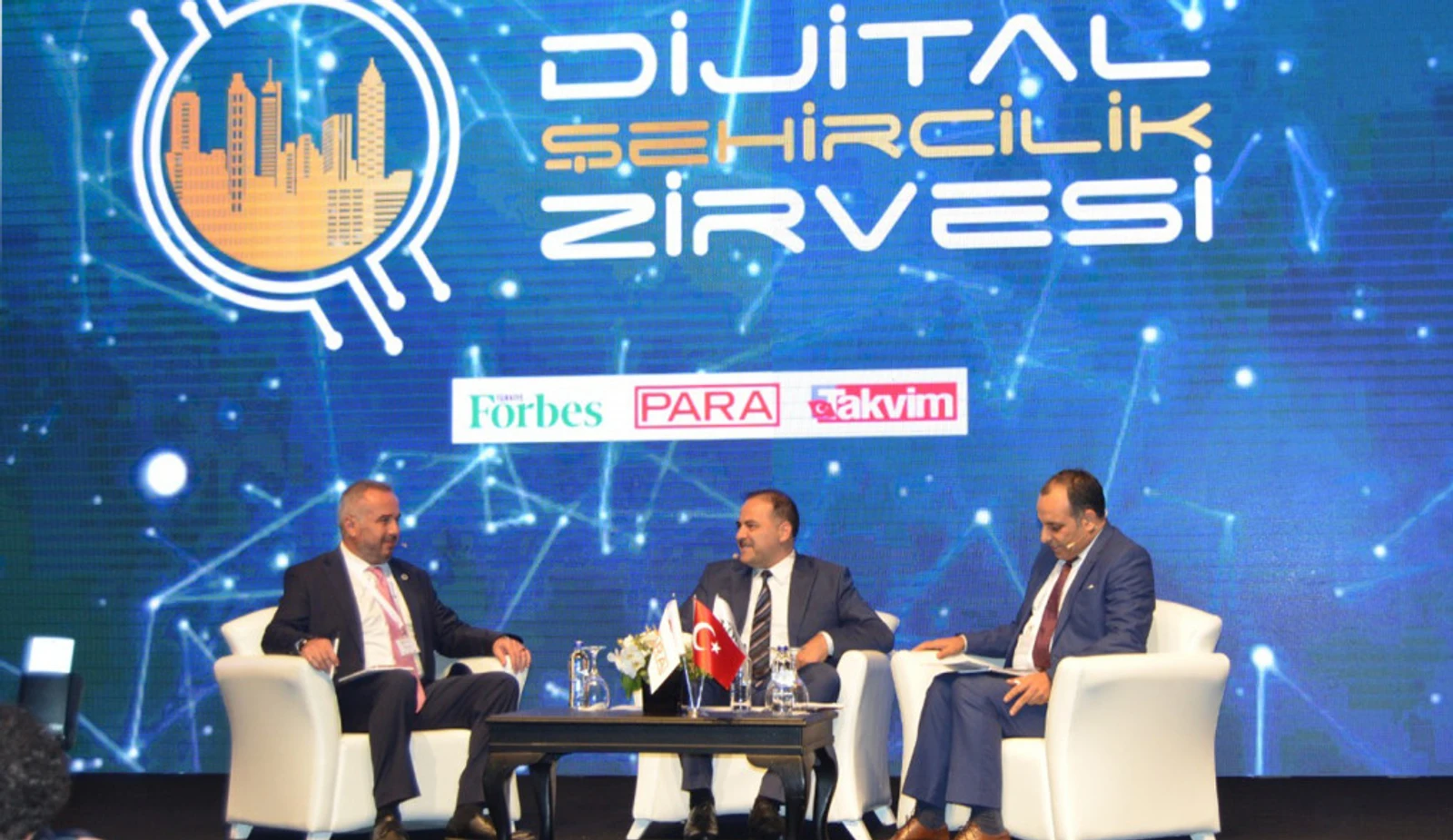
Digital Urbanism Summit Discussed in Istanbul.
Topics on how smart cities will change our lives were put on the table at the “Digital Urbanism Summit” organized by A Para in Istanbul. Participants included Dr. Ömer Fatih Sayan, Deputy Minister of the Ministry of Transport and Infrastructure, mayors of major cities such as Istanbul, Balıkesir, Kayseri, Konya, and sector representatives.
Responding to questions about Digital Cities, Deputy Minister Sayan stated, “In recent periods, as you mentioned, the word ‘smart’ has started to be added to the beginning of many definitions. It is possible to give many examples on this topic, such as smart objects, smart cars, smart homes, smart cities, smart buildings, and smart factories. So, when does a home or a coffee machine become smart? What is meant here is not the skill shown by the object while performing its own tasks. In other words, a coffee machine having many features within itself and successfully making different coffees does not make it ‘smart’ in the current sense. What makes a device or a building smart is its ability to collect information through sensors, receive data from other devices while performing its tasks, send data to these devices, in other words, communicate with its surroundings, and differentiate its work by interpreting this data. The coming together of Smart Objects also forms larger structures such as smart buildings and cities. While many sub-units in a building, such as heating-cooling, security, cleaning, and lighting, may consist of perhaps hundreds of objects within themselves, these systems work together by interpreting this data. It is possible to give many examples within the scope of smart city applications. When we consider municipal services, new communication opportunities with citizens are emerging through internet-connected devices, and data collection and analysis capabilities are increasing. Thanks to this, municipal services can be shaped in a citizen-centered manner.”
Deputy Minister Sayan: Citizens Should Be Cautious Regarding the Security of Their Personal Data
Emphasizing that developments in the field of information technologies, the rapid spread of technological services, and the increasing data traffic between countries have brought along the issue of personal data protection, Sayan said, “Today, technological developments such as social networks, cloud computing services, big data analysis (Big Data), location-based services, and smart cards, which are widely used, along with the necessities brought by globalization, deeply affect and change methods of access to personal data, collection, and use of data. Therefore, in recent years, especially in our country and European Union countries, efforts to align data protection legal infrastructures with current technological developments have been increasing. In our country, the right to protection of personal data was included as a constitutional right with the constitutional amendment made on September 12, 2010. The norms regulated regarding the protection of personal data aim to prevent the processing of individuals' most fundamental right, their personal data, in a way contrary to their explicit consent within the framework of equity without obstructing technological and sectoral developments. Therefore, yes, everything is becoming smart, and citizens should be aware of this and be cautious regarding the security of their personal data in every transaction they make. Regarding transparency, studies continue on ensuring that personal data is not processed or transferred without the citizens' explicit consent at least.”
Deputy Minister Sayan: ITS is a New Wave in the World
Intelligent Transportation Systems (ITS) were also on Deputy Minister Sayan’s agenda. Stating that this topic is important for managing traffic in cities and reducing traffic congestion on roads, Sayan said, “Important traffic management solutions include smart signal systems, traditional signaling and video surveillance systems, route guidance systems, and smart video management systems. It would not be wrong to say that increasing traffic congestion in big cities around the world due to lack of adequate parking spaces, increasing number of vehicles, poor traffic management, and inefficient infrastructure and systems will increase the demand for this solution. ITS is still a new wave in the world, and those who can catch this wave will undoubtedly achieve sustainable development. Today, Japan, South Korea, the United States, the Netherlands, Singapore, and the United Kingdom are leading in implementing ITS. Japan’s main goal in this field is built upon integrating people, roads, and vehicles with the help of information and communication technologies to solve traffic problems such as reducing traffic congestion, traffic accidents, and environmental impacts. Intelligent Transportation plans include activities such as developments in navigation systems, electronic toll collection systems, support for safe driving, optimization of traffic management, increasing efficiency in road management, supporting public transportation, increasing efficiency in commercial vehicle operations, and assisting pedestrians and emergency response vehicle operations.”
Sayan also provided the following information regarding the National ITS Strategy Document, prepared in coordination with the Ministry of Transport and Infrastructure by taking the opinions of all relevant institutions, organizations, and social stakeholders:
“• Making public transportation stops in the central districts of all metropolitan cities smart,
• Developing administrative and technical legislation according to national and international needs and creating a national-level ITS architecture in this scope,
• Encouraging domestic production in software and hardware used within the scope of ITS,
• Widespread implementation of applications nationwide to increase traffic safety and mobility, making traffic management effective and efficient on intra-city and inter-city road networks,
• Widespread use of e-payment systems in transportation, development of applications in case of accidents and emergencies,
• Facilitating access of people with mobility restrictions to transportation vehicles and services through ITS,
• Developing environmentally friendly applications that ensure energy efficiency, producing solutions to reduce emissions in urban transportation.”