


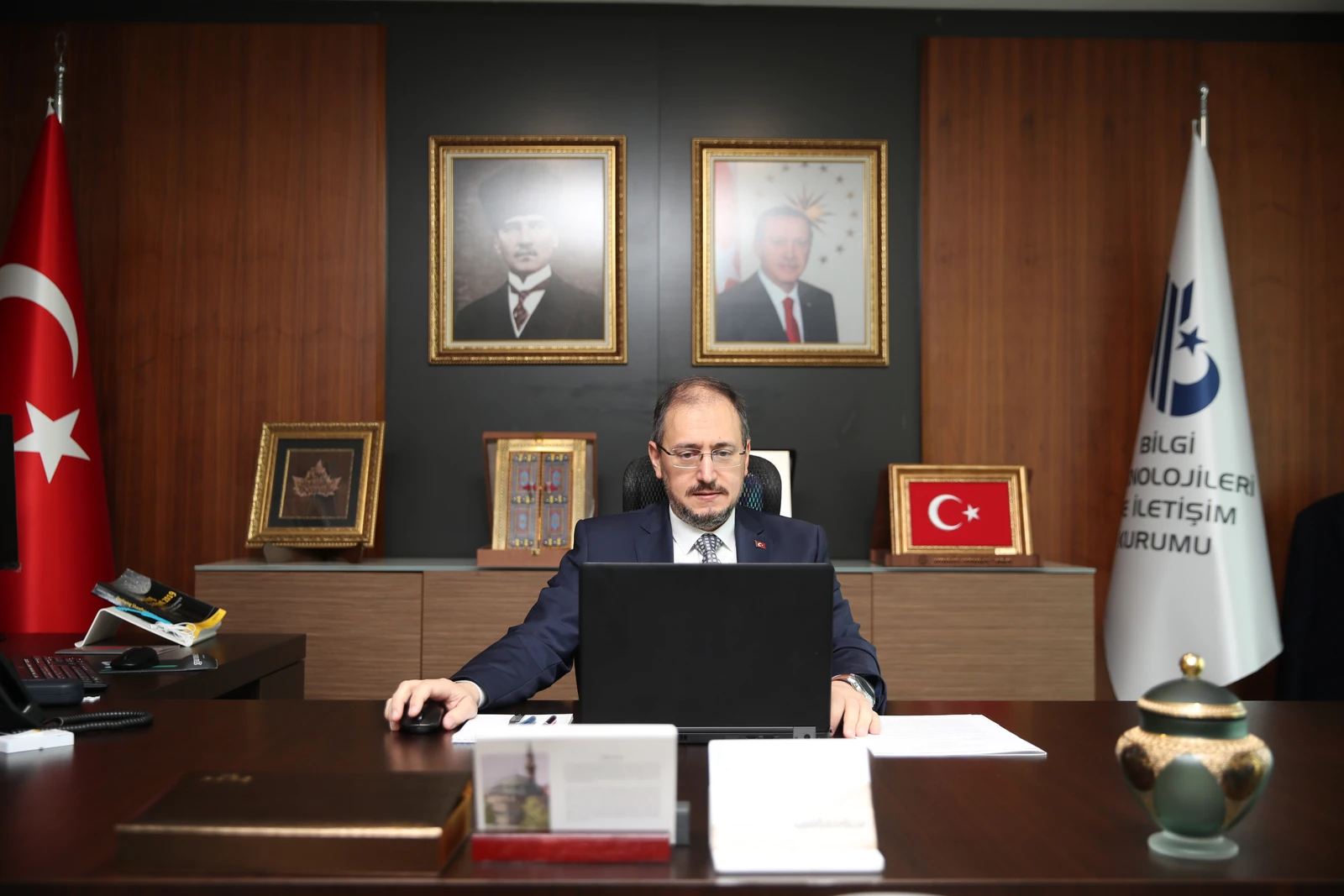
Information Technologies and Communication Authority President Ömer Abdullah Karagözoğlu participated in the “Future of Trust” event organized by IDC Türkiye in the digital environment.
In his speech, President Karagözoğlu emphasized the importance of cybersecurity for countries. Stating that the rapid development of information technologies has made computer and internet usage an indispensable part of life, Karagözoğlu said, “As technology advanced, information multiplied, and as information increased, technology took on a completely new form. However, it also brought some problems. The sudden widespread use of informatics and the internet around the world provides convenience and freedom to users, but since it poses a threat to information security, the effective and reliable use of information and communication technologies has become essential for all of us. About 25 years ago, only about one percent of the world's population used the internet. Today, we have reached numbers expressed in billions. Approximately 4 billion people have access to the internet, and new ones are added every second. Our children step into the online world before they even start school life. As the numbers rise, our dependency on the internet increases, and as this dependency grows, so do our data. And we become more vulnerable in this ever-expanding cyber world. Of course, if we do not take the necessary measures.”
Stating that the cyber world is powerful enough to engulf states, Karagözoğlu said, “We may be even more aware of its importance today. The pandemic process we experienced has once again demonstrated how crucial the cyber world and ensuring its security are. Since we lived the normals of our virus-restricted lives through the internet, the cyber world gained even more importance. As an Institution, we took all measures to protect our citizens from cyberattacks themed ‘Coronavirus’ or ‘Covid-19’ in the cyber environment. During the pandemic process, we implemented all necessary measures from the very first moment for the security of both our citizens and operators,” he shared.
Karagözoğlu: We Took All Measures to Facilitate the Pandemic Process
Stating that they took all measures to facilitate life by considering all aspects of life during the pandemic process, Karagözoğlu said, “In these days when the Coronavirus (COVID-19) outbreak is raging at full speed and people are spending a significant portion of their time at home for social isolation purposes, just like in the rest of the world, the electronic communication and postal sector stood out as important supporting sectors in our country. In addition, within the scope of the work carried out with operators providing services in the communication sector in our country, we monitored the service continuity of operators in real-time. We monitored voice and data traffic based on increasing bandwidth capacity and ensured that necessary measures were taken in case of any bottlenecks. Also, due to the interruption of formal education during this process, the traffic of the EBA systems, which is the online education platform of the Ministry of National Education, was monitored by USOM for service continuity and against any possible problems through collaborations with operators. I would like to happily convey that as a result of our analyses and measures taken, we did not experience any issues affecting service continuity in our communication infrastructure.”
In addition to preventive measures, expressing that they were on high alert against the increasing cyberattacks during this period with applications named KASIRGA, AVCI, and AZAD, which they developed entirely with their own resources and based on machine learning and artificial intelligence capabilities, Karagözoğlu listed what was done in this context as follows: “As a result of the examinations and malicious software analyses conducted, we created signatures for mobile applications and malware, enabling the rapid detection of these malicious activities. We published a threat intelligence report related to Covid-19 through the Some Communication Platform. The report included the examination of 42 malicious software and information on 569 malicious software. In threat intelligence studies, we conducted threat hunting by writing signatures to detect fakes of the most well-known conference applications, and our work continues in this regard. In this scope, we detected 146 fake conference applications and took the necessary actions. Especially due to the increased use of remote working methods, we scanned remote management services (Remote Desktop, etc.). 7816 vulnerabilities were detected, and we made the necessary warnings to relevant public institutions and organizations through SİP and official letters. We blocked 482 malicious droppers and command-and-control centers related to Covid-19. We conducted scans targeting domain names related to the COVID-19 virus using artificial intelligence.”