



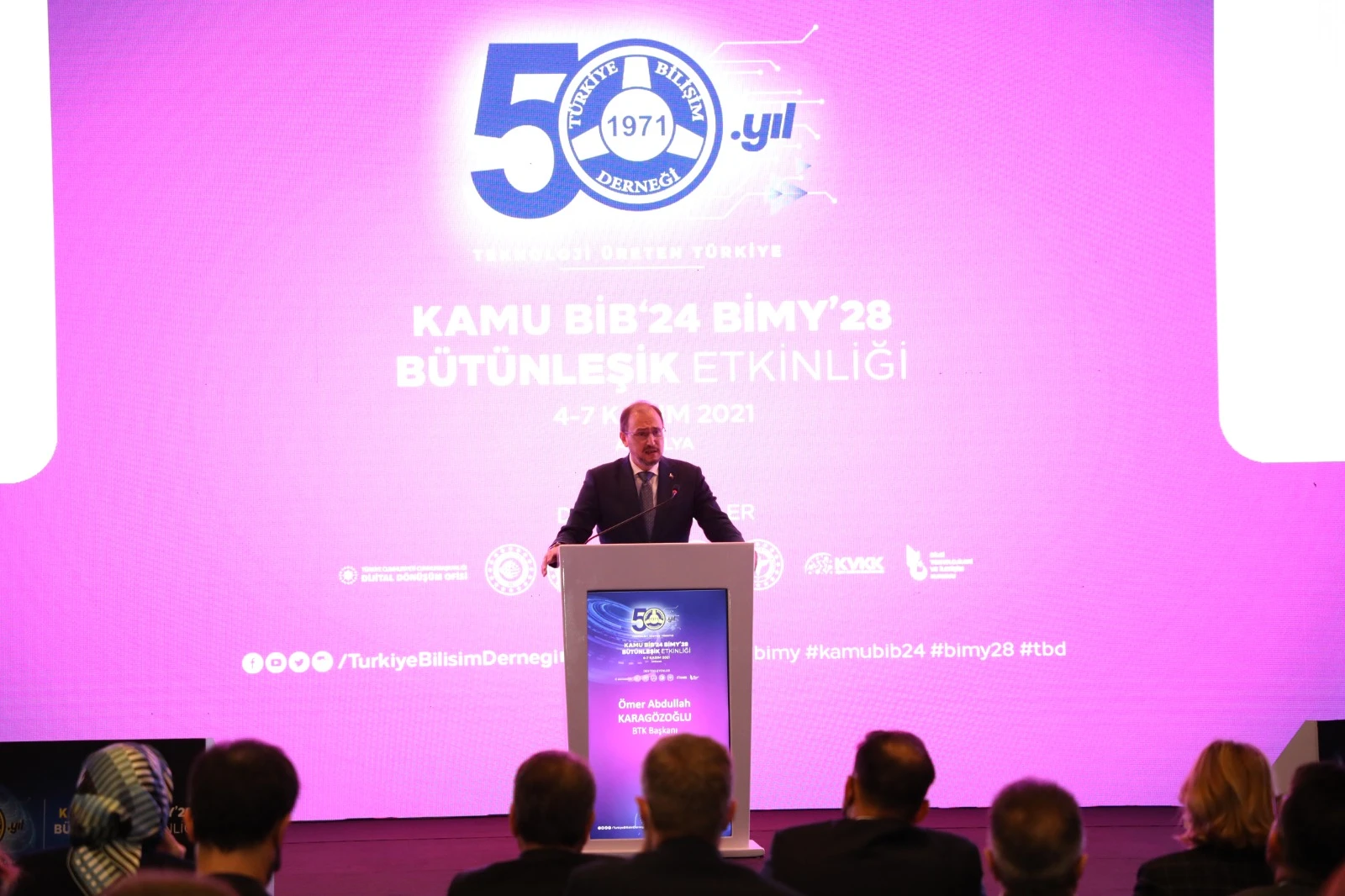
Information Technologies and Communication Authority President Ömer Abdullah Karagözoğlu attended the “Public-BIB’24 and BIMY’28” meeting organized by the Turkish Informatics Association.
At the meeting organized by TBD, where Turkey's efforts to transition to an information society were discussed, BTK President Ömer Abdullah Karagözoğlu provided information on the current state of technology and began his speech by saying, “Due to the almost limitless opportunities offered by technology, there is significant potential for important work worldwide, especially in the R&D field. Efforts are underway in nearly every sector to bring ideas to life and to use resources effectively and efficiently.”
Reminding that information technology governance is gaining increasing importance, Karagözoğlu stated, “All institutions aim for effective and productive work in line with their goals. In this regard, information technologies constitute one of the most important tools used by institutions to achieve their objectives. Institutions' successes are now almost measured by their success in information technology governance. Therefore, we must address corporate governance and information technology governance together. Institutions should integrate their administrative structures with the necessary information processes and implement these processes with high interaction and participation.”
Karagözoğlu also touched upon the increase in e-commerce traffic with the pandemic. Pointing to the growth in this area, Karagözoğlu said, “When we look at the data; in the first 6 months of 2020, there was a 64% increase compared to the same period in 2019, and as of the first 6 months of 2021, we see that the e-commerce volume in our country reached 161 billion TL with a 75.6% increase compared to the same period of the previous year. While e-commerce offers global opportunities to businesses, it also gives companies undergoing digitalization the chance to grow very rapidly independent of geography. Our country has significant potential in e-commerce due to its geographical location and dynamic structure.”
Emphasizing the importance of our country making the right investments on the path to digitalization, Karagözoğlu shared, “When we look at our country's infrastructure and usage data, we see that our mobile subscriber count is approaching 85 million, 93% of which are subscribers receiving 4.5G service, and mobile penetration exceeds 101%. We see that the average time spent online in our country is 8 hours. With the necessity of our lives moving to the virtual world after the start of the pandemic, the upward trend in our internet subscriber numbers has accelerated. As of the first half of 2021, the total broadband subscribers reached 85.7 million, and data usage amounts showed a 39% increase in fixed and 31% in mobile compared to the same period of the previous year. With the increasing need for high-speed internet, fiber infrastructure length has reached 445 thousand kilometers, and fiber internet subscriber count has reached 4.3 million.”
5G was also on President Karagözoğlu's agenda. Once again underlining the importance of using 5G in a domestic and national manner, Karagözoğlu spoke about the studies they conducted as an institution under the guidance of the “National Technology Move.” Karagözoğlu said, “6G networks aim to introduce us to new intelligent application technologies with the help of artificial intelligence and machine learning technologies. Compared to 5G, 6G wireless communication networks are expected to provide much higher spectrum, energy, and cost efficiency, higher data rates, 10 times lower latency, 100 times higher connection density, more automation capabilities, and latency below milliseconds.”
Also mentioning that these technological opportunities may have some dangers, Karagözoğlu concluded his speech by saying, “Sustainable success can never be coincidental. We take pride in reaping the rewards of our dedicated efforts. One of the most important elements of this motivation and success is having domestic and national technology. The more domestic and national technology we possess, the stronger and more independent our cybersecurity structure will be, which is obvious. In this context, AVCI, AZAD, KASIRGA, ATMACA, and KULE applications, developed entirely with internal institutional resources in a domestic and national manner within BTK, are working tirelessly to ensure our cybersecurity, and we will continue to do so.”