





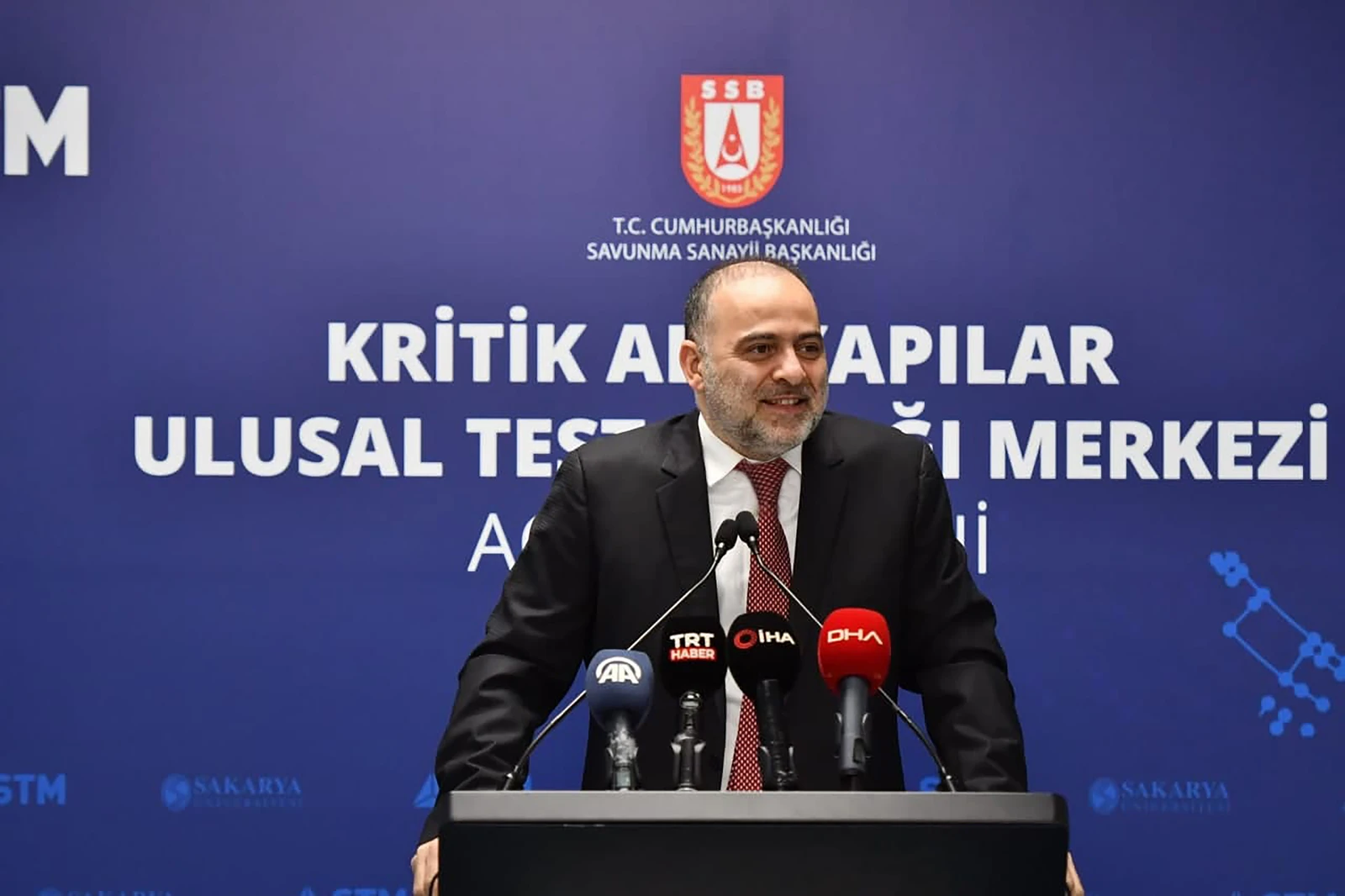
Ministry of Transport and Infrastructure Deputy Minister Dr. Ömer Fatih Sayan attended the opening ceremony of the National Test Bed Center for Critical Infrastructures.
Under the leadership of the Presidency of Defense Industries (SSB), with STM Defense Technologies, Engineering and Trade Inc. as the main contractor, in collaboration with Sakarya University, the “National Test Bed Center for Critical Infrastructures,” whose signatures were signed last year, has been opened. Deputy Minister of Transport and Infrastructure Dr. Ömer Fatih Sayan, who attended the opening of the program, emphasized the technological importance of the center.
Pointing out that technology is developing at a great speed in every field today, Sayan said, “Critical infrastructures form the basic building blocks that increase the welfare level of a country and the people living in it and are needed throughout life. The criticality of infrastructures is measured by the magnitude of the impact it will create when they do not function healthily or become unusable. A problem that may occur in these systems can cause great damage to the state's and society's security, as well as values such as economy, health, and welfare. We know that information and communication infrastructures have a separate importance due to their relationship with all other infrastructures among critical infrastructures. Because today, information and communication technologies are in a key position for development in every sector. Information and communication technologies are increasingly used in every field from transportation to energy, from finance to education, from health to industry,” he said.
Stating that benefiting from technological opportunities increases the quality of life, Sayan said, “While cyber security is of great importance on its own, this importance level increases even more when critical infrastructures are concerned. In recent months, examples have been experienced in many countries where developments starting with the seizure of a small control system through cyber attacks plunged the entire country into darkness. Most likely, we have all watched a movie where hackers disrupt the city's transportation and signaling systems, all traffic lights turn green at the same time, the entire city's electricity and water are cut off, false alarms are triggered from everywhere in the city, financial hackers infiltrate the financial system, render the banking system unusable, large amounts of money move between accounts, and thus drag people into great fear and panic, paralyzing life. These scenarios are now frequently tried in the cyber realm. Countries are virtually forced to kneel with these attacks. Therefore, taking the necessary measures to protect critical infrastructures and sectors is as important and necessary as standing guard at the border 24 hours a day, monitoring our airspace with radar,” he stated.
Deputy Minister Sayan: Protecting Critical Infrastructures Is Not Just a National Issue
Emphasizing that protecting critical infrastructures is not just a national issue, Sayan said, “We know that if one of the critical infrastructures of a country like Turkey, which has geostrategic importance, becomes dysfunctional, large-scale problems may arise not only within the country but also in the countries that receive services through our country's infrastructures. For example, in the face of an environmental, physical, or cyber threat to the oil-natural gas pipelines passing through our country, not only our country but all countries importing energy through our country will be affected. In the cyber incidents that occurred in the recent past, we witnessed that developments starting with the seizure of a small control system could affect the entire country. In recent years, cases were encountered where computer systems of energy centers in Georgia, Estonia, Iran, and the USA were infiltrated and thousands of people were left without electricity. Considering the importance of energy, hence electricity, in today's technology, it is clearly seen what kind of damage such attacks in energy centers could cause to the relevant country. On the other hand, it is known that in the cyber attack on Düsseldorf Hospital last year, a patient connected to a respiratory device became the first person in history to lose their life in a cyber attack due to the electricity of the devices being cut off. Especially during the Covid-19 pandemic period we are in, the consequences of such an attack in the health system would unfortunately be irreparable,” he warned.
Deputy Minister Sayan: Developing the Domestic and National Ecosystem Is Our Strategic Goal
Describing the work done by the Ministry in this field, Sayan said, “As the Ministry, in line with the ‘National Technology Move’ initiated by our President, we see the development of a sustainable domestic and national ecosystem in the field of information and communication technologies as a strategic goal and attach great importance to the work done in this area. In the understanding expressed by our President in one of his speeches, ‘The main thing is not to buy ready-made technology and learn to use it, but to design, develop, and produce technology,’ we are continuing our efforts to develop and produce 5G and beyond technologies with domestic and national capabilities.”
Also reminding the importance of university-industry collaboration, Sayan said, “The National Test Bed Center established through the cooperation of Defense Technologies Engineering and Sakarya University constitutes a good example within this scope. We are pleased that this established center will contribute to capacity building in the security of critical infrastructures, transformation of academic studies into domestic and national concrete projects through university-industry collaboration, and increasing the resilience related to the cyber security of critical infrastructures. The fact that the Center will also turn into an R&D center excites us greatly. I believe that the National Test Bed Center will also increase initiatives towards domestic and national production in line with the 2023 targets by modeling academic studies in a real environment,” he concluded his speech.