





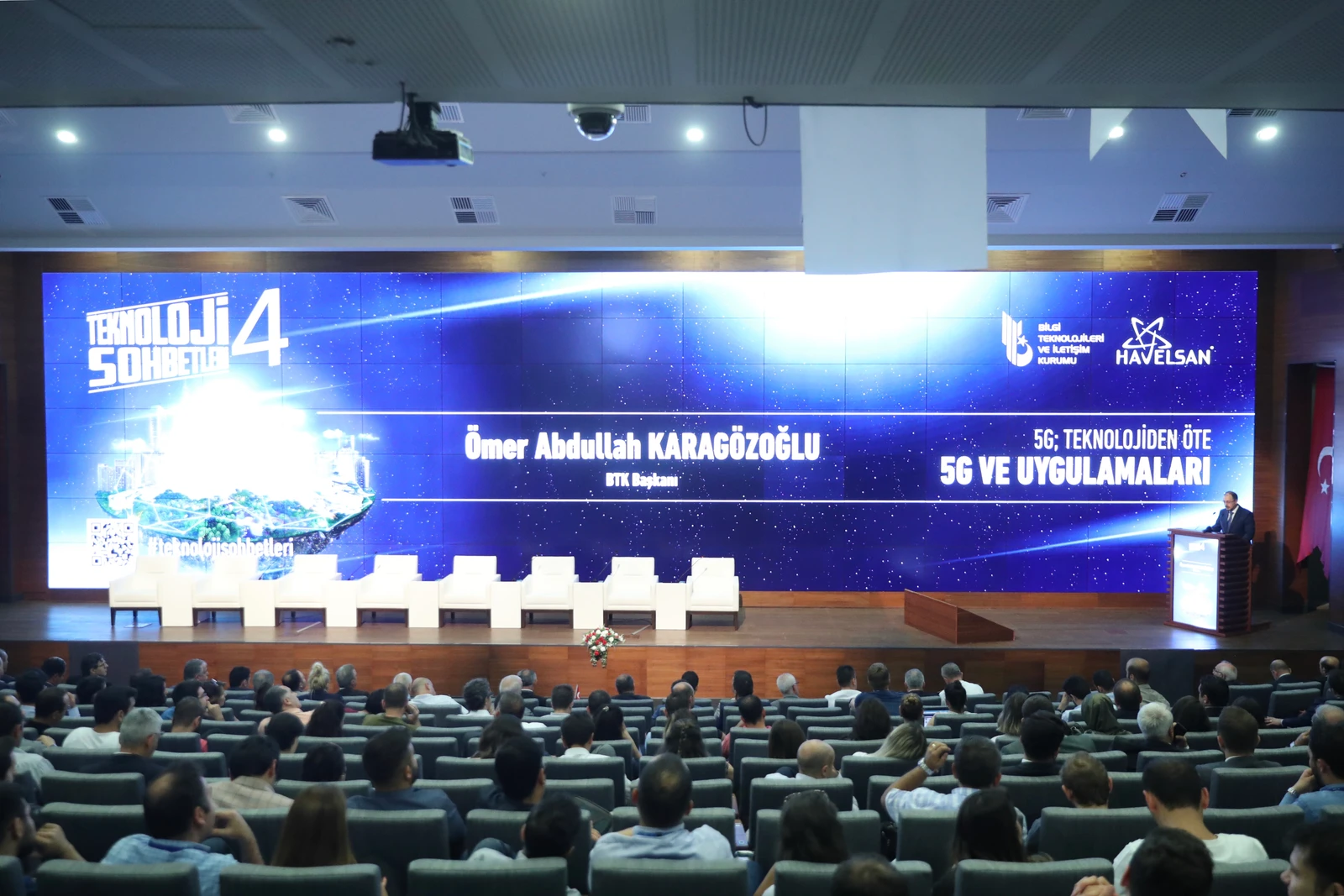
The fourth Technology Chat was organized by HAVELSAN under the auspices of the Information Technologies and Communication Authority.
Information Technologies and Communication Authority President Ömer Abdullah Karagözoğlu delivered a speech on the importance of 5G at the opening of the program.
Reminding the goal of becoming a country that produces completely domestic and national technology products by 2023, Karagözoğlu emphasized that the transition to 5G will be made simultaneously with the whole world. Stating that 5G will not only affect mobile communication, Karagözoğlu said, “It will be a technology that permeates our lives in all areas you can think of, from health to automotive, from entertainment to the service sector. Autonomous vehicles, augmented reality, virtual reality, and artificial intelligence applications will gain a new dimension with 5G and beyond. Everything will be connected everywhere, at high speed and capacity, with minimal interruption and delay.”
Drawing attention to the increase in Internet of Things (IoT) applications particularly with 5G, Karagözoğlu shared the following data regarding future expectations: “It is predicted that by 2025, there will be 100 billion different connections worldwide, and only 10% of these connections will be between people. Also, after 2020, the average data circulating per km² in the world will increase 16-fold every 4 years; it is estimated that 25 times more frequency and 2000 times more base stations than the previous generation will be needed to meet this demand.
In this context, by the end of 2023, the number of 5G network subscribers is expected to reach approximately 1 billion, and global mobile data traffic is expected to exceed 100 exabytes per month. On the other hand, it is predicted that 49% of all subscriptions in the US will be 5G in 2025, and 245 million 5G connections will be realized in Europe.”
Expressing that as an institution, they are fulfilling their duties in the best possible way on this path, Karagözoğlu stated, “Unlike previous generations of communication technologies, the transition to 5G will not happen overnight but through various technologies that are starting to be offered by integrating into existing systems. This brings us some challenges in terms of technology management, while also providing opportunities to make advances in priority areas in terms of technology production and preparation.”